There’s a fundamental decision at the core of every men’s diamond watch purchase, and it’s not about budget. It’s about design intent. How much of the diamond presence do you want visible at any given moment? An understated piece uses stones where they enhance the watch’s formal quality without defining its character. A statement piece uses stones as the primary visual element. Both approaches are legitimate; the right choice depends on context and preference, not on which position is more sophisticated.
The Case for Understated
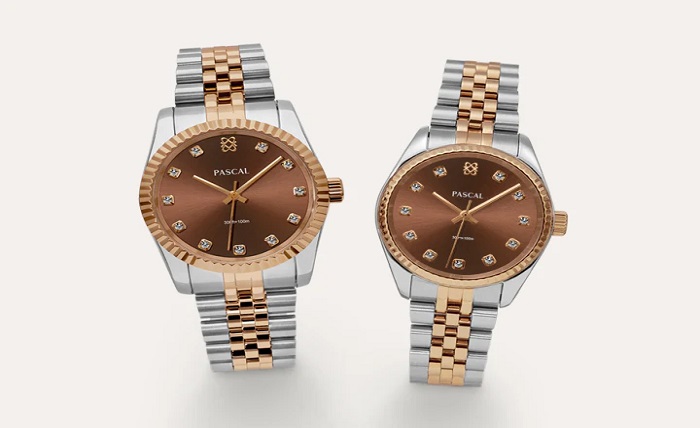
Diamond hour markers are the classic execution of the understated approach. Small stones at 12, 3, 6, and 9 positions — or at all twelve hours on dress models — register as luxury in person without creating strong directional sparkle. The watch reads as a quality dress piece in professional environments. The diamonds are visible on close inspection; they don’t announce themselves at arm’s length.
For PASCAL men watch with diamonds, the Timeless Classic series applies this approach: up to 0.15 ct of diamond markers distributed across the dial, set into the hour marker positions rather than placed on the bezel or case. In most professional contexts — office environments, business meetings, formal events — this registers as “quality watch” before it registers as “diamond watch.” That sequence matters to men who want the craftsmanship visible without the ornamentation being the first thing someone notices.
The Case for Statement
The Paradoxe collection makes the opposite argument: 0.3 ct of lab-grown diamonds encircling the asymmetric bezel, creating visible diamond presence from a conversational distance. This is a watch designed to be noticed — and designed for contexts where being noticed is appropriate. Evening wear. Social events. Environments where jewelry carries explicit conversational weight. Men who wear rings, chains, and have an established jewelry register will find the Paradoxe a coherent extension of an existing vocabulary. It’s not louder for its own sake — it’s appropriately scaled for specific contexts.
Movement Below the Stones: Why It Matters
The watch underneath the diamonds needs to be worth wearing independently. A weak movement in an expensive case is the worst outcome in the category: you have a piece that signals quality it can’t substantively deliver. Swiss quartz movements at ±15 seconds per month accuracy are the standard for a diamond watch worth the investment. Generic movements at ±60 seconds create a practical failure that becomes apparent within weeks of daily wear.
PASCAL uses Swiss quartz movements across their men’s diamond collection — the same movement standard whether you’re in the understated or statement camp. The diamonds are placed on top of something genuinely worth wearing, which is the baseline requirement for a piece to hold up over years of daily use.
How to Start If You’re New to Diamond Watches
Most men entering the category for the first time land better with the understated approach. The commitment threshold is lower — diamond markers at the hour positions are far easier to wear to a Monday morning meeting than a full diamond bezel — and the versatility is higher. If you wear it consistently for several months and find yourself wanting more visual weight, you know where to go from there. The reverse journey — scaling back from a statement piece that turned out to be too much — involves buying a new watch.
PASCAL‘s men’s collection covers both ends: understated daily pieces built for the five-day week and bolder statement models for the weekend and evening. The lab-grown diamond quality (D-F color, VVS-VS clarity) and construction standard (316L stainless, Swiss quartz, 24-month warranty) applies across both — so the only decision is really how much presence you want on a given wrist.